A design team hits 40,000 images spread across three shared drives, a Slack workspace and someone’s laptop. The obvious diagnosis is that they need more space, or tidier folders. Both are wrong.
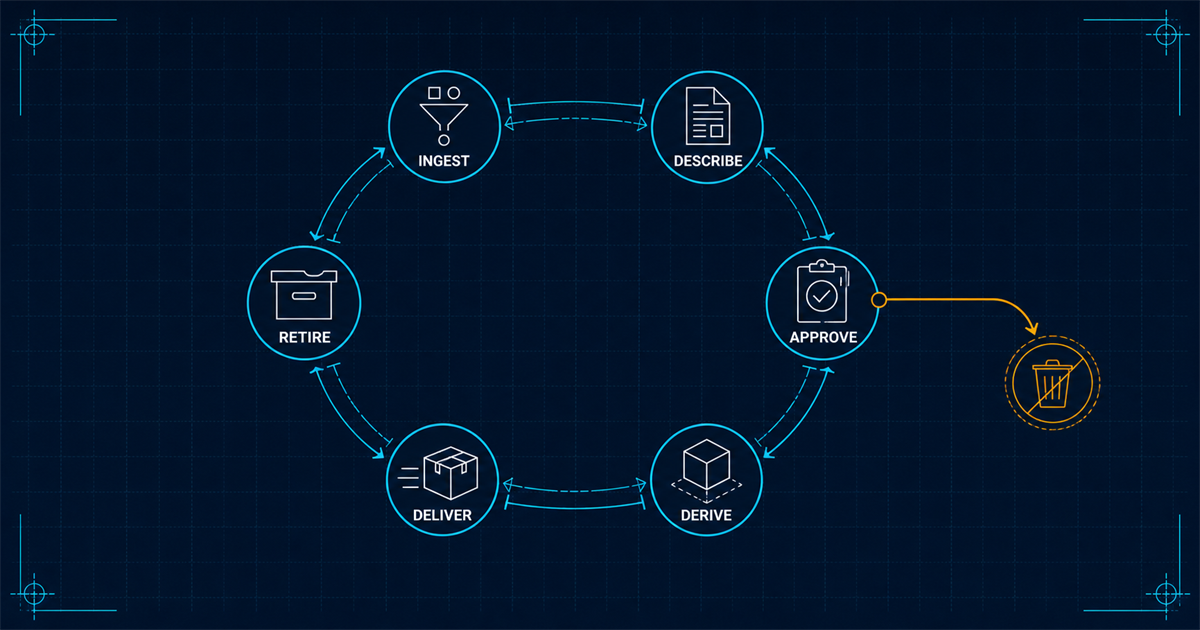
Short answer: digital asset management is not storage. It is the practice of keeping an asset’s context attached to the asset itself, for the asset’s whole life, so that a person or a piece of software can act on it without guessing. Storage answers where the file is. A DAM answers what it is, whether you are allowed to use it, what it was made from, and how it should look wherever it lands.
That distinction is the entire subject. Platforms like Cloudinary Assets exist to close exactly that gap: one stored original that carries its own description, approval state and history, and derives whatever the requesting context actually needs.
The difference between a file and an asset
A file in a folder is a byte string with a name. That is the whole contract. Everything else you know about it lives outside it: in a naming convention someone invented, in a spreadsheet, in a Slack thread, or in one person’s head.
An asset carries its own context. Ask it what it is and it answers. Ask it whether legal cleared it and it answers. Ask it what already exists derived from it and it answers.
The reason this matters is not tidiness. It is that every downstream decision depends on knowledge that a file does not hold:
- Which crop goes on the product page. Needs to know what is depicted and where the subject sits.
- Whether this photo can run in a paid ad. Needs a licence term and an expiry date.
- Whether the 2024 packshot is still current. Needs version lineage.
- What alt text to write. Needs a description that was captured once, not invented per placement.
Do any of that from a folder and you are reconstructing the same facts, from nothing, every single time.
What is digital asset management in one sentence?
Digital asset management is the system of record for your media: one authoritative copy of each asset, described well enough that anyone or anything can find it and use it correctly without asking a human.
The general definition covers ingest, annotation, cataloguing, storage, retrieval and distribution. That list is accurate and slightly misleading, because it puts storage in the middle of a sentence where it deserves a footnote. Storage is the cheap part. Annotation and retrieval are the product.
The five things an asset should carry
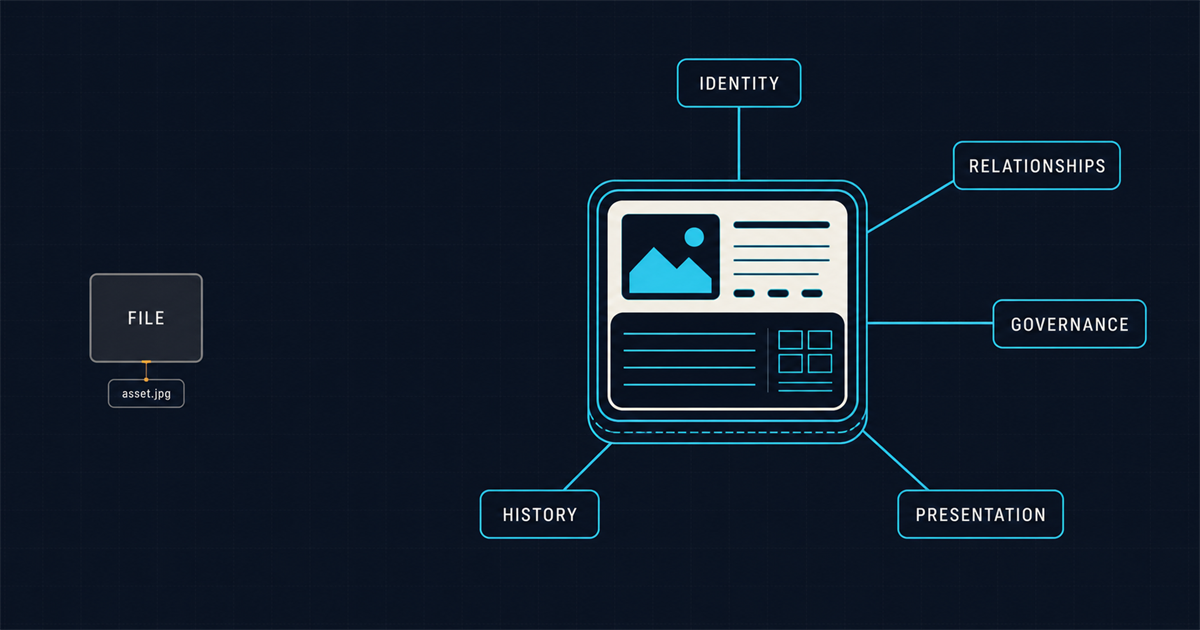
If you want a working definition to evaluate any platform against, use this. An asset should know:
- Identity. What it is: format, dimensions, what is depicted, semantic tags, where it came from.
- Relationships. What it connects to: which original it derives from, which campaign it belongs to, which product it shows.
- Governance. What is allowed: approval state, licence terms, expiry, brand compliance, moderation status.
- History. What it has done: versions, who changed what, where it has been published.
- Presentation. How it renders: the rules for producing the right variant for whatever context asks.
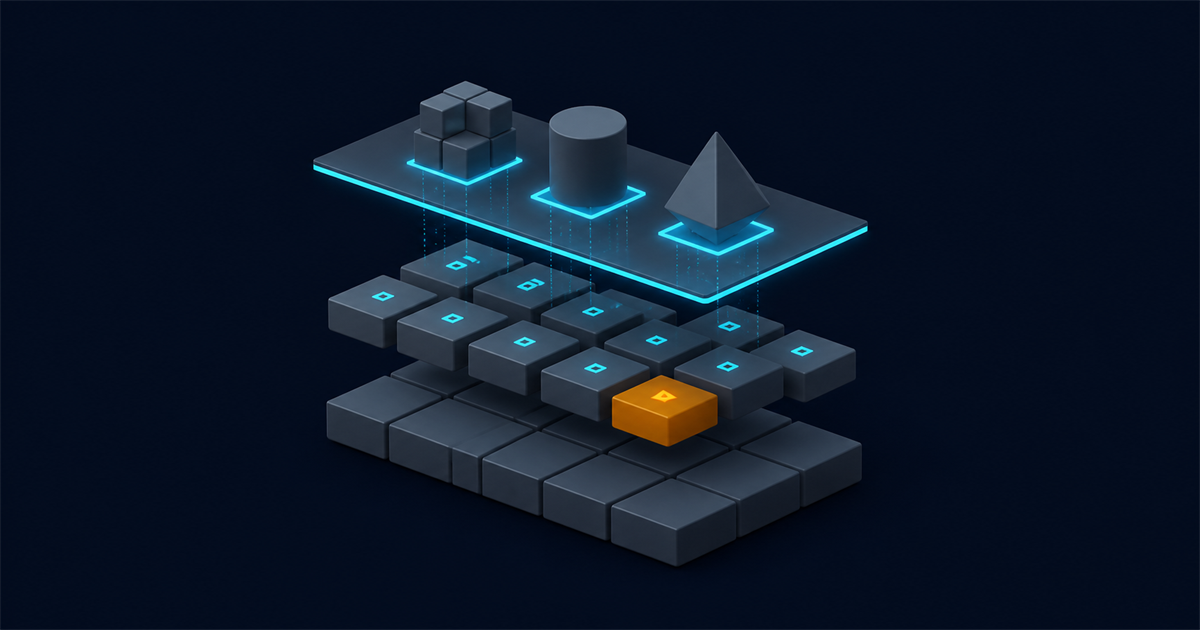
Every one of those is metadata, which is why metadata is the whole product rather than a feature you configure later. A platform that stores files beautifully and describes them poorly is a slow, expensive drive.
Standards exist for most of this. IPTC Photo Metadata covers creator, description, rights and location for photography, and it is embedded in the file itself, so it survives leaving your system. Schema.org ImageObject covers the same ground for anything you publish on the web. Use them where they fit and put your own fields around the edges, not the other way round.
What a DAM is not
Four things get called a DAM that are not one.
Cloud storage with sharing. Dropbox, Drive and OneDrive give you a hierarchy and a link. They do not give you controlled vocabulary, approval state or derivation. This is the most common substitution and it fails in a predictable order.
A CMS media library. It holds the assets your website uses. It has no view of the assets your website does not use, which is most of them, and no concept of an asset existing before or after a page. The boundaries between DAM, CMS and PIM are worth drawing on paper before you buy anything.
A brand portal. Useful, and a downstream surface of a DAM rather than the thing itself. A portal distributes approved assets. It does not manage the ninety percent that are unapproved, in progress or retired.
A CDN. Delivery is a solved commodity. Every serious platform does format negotiation and resizing. Buying a DAM for delivery is buying a library for its front door.
When you do not need one
Be honest about the threshold. If you have a few hundred assets, one person making them, one place they get used and no licensing exposure, a well-named folder is correct and a DAM is overhead you will resent. The signal is not asset count on its own. It is the number of people who need to answer questions about an asset that they cannot answer by looking at it.
There is a real checklist for that decision in do you need a DAM yet, including the cases where the answer is no.
Where this goes next
The interesting shift is who is asking the questions. It used to be a designer looking for the right logo. Increasingly it is a build script, a front end, or a coding agent that will never open your admin interface and has no way to ask a colleague. That caller cannot infer anything a file does not state. It either queries structured context or it guesses.
That is why the definitional argument matters more now than it did five years ago, and why the platform choice is less about storage tiers than about what your assets can be asked. If you are at the shortlist stage, DAM platforms compared by who they are actually for sorts the market by fit rather than by feature count.
Related field note
Continue with The rollback plan for orphaned asset detection.
Related field note
Continue with A practical checklist for brand consistency controls.
Related field note
Continue with Asset approval evidence without duplicate files.